


.jpg)
Inspired by those surprises, for my week-long road trip across the province, I wanted to see where the tides took me. I had a start and end point each day, but beyond that, I hadn’t planned any specific activities, hikes or sightseeing.
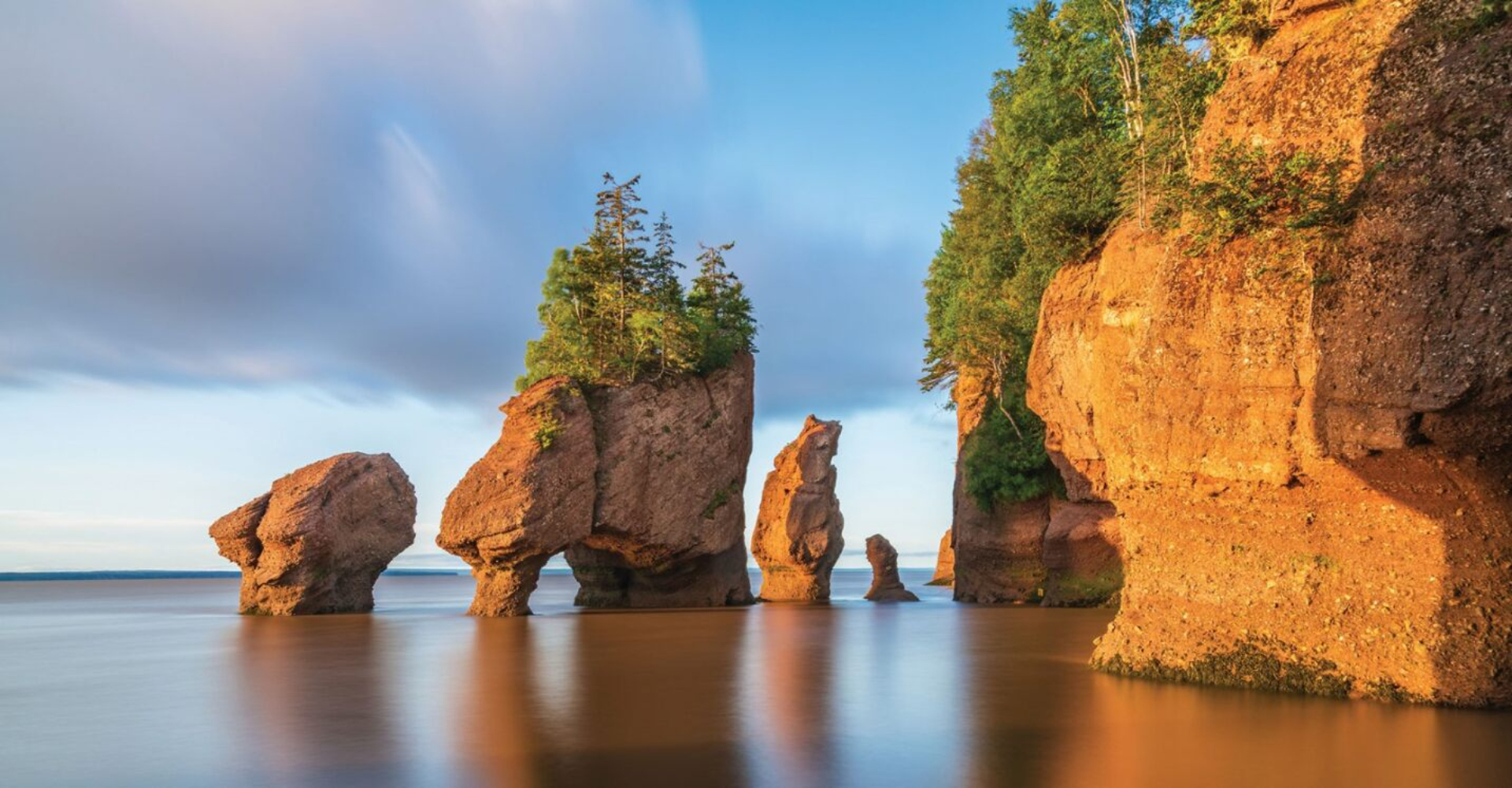
I started out at Hopewell Rocks, without a doubt the most recognizable landmark in New Brunswick. There’s no better example of towering feats of nature shaped by water. The Bay of Fundy is home to the highest tides in the world, reaching an astounding 16 metres in height at high tide twice a day. Standing precariously in the Bay, the ebb and flow of 160 billion tonnes of seawater per tidal cycle have been carving these imposing formations, also known as Flowerpot Rocks, for millions of years.
The tidal erosion has shaped the rocks into arches and pillars you can weave between and underneath at low tide. It’s one thing to see them in photos; but when I was walking along the exposed seafloor, staring up at the improbable shapes, I felt that awe of witnessing something millions of years old. Once the tide rises, you can return to kayak between the rocks you were walking beneath just hours before, seeing them in a whole new way.
As you drive southwest from Hopewell Rocks, avid hikers eager for an elemental adventure can stop along the Fundy Trail Parkway to see Walton Glen Gorge. Nicknamed the “Grand Canyon of New Brunswick,” the Walton Glen Gorge Lookout Trail is a short hike to a spectacular view at the edge of a cliff, overlooking a 40-metre drop into the gorge below. But the real natural feat drawing us in is further along: a steep backcountry descent into the upper gorge that takes you to a stream you’ll follow all the way to the Eye of the Needle.
“The province’s landscape is home to natural phenomena you rarely see elsewhere—like towering flowerpot-shaped rocks and a river that appears to reverse its flow.”
.jpg)
.jpg)
The Eye of the Needle is a place in the gorge where the cliff walls narrow to just about three metres apart, and the stream funnels into a pool through the opening. The only way out is through: you’ll find yourself wading into the cold waters, reaching out to touch the rock formations on either side of you as you pass. This trail does go outside the boundary of the Fundy Trail Parkway. It requires some caution when climbing down the cliffs beside the waterfall, but experienced hikers know it’s well worth the adventure.
From there, you can also experience high and low tides again in nearby St. Martins, a charming fishing village. The sandstone sea caves have been carved out by the Bay of Fundy’s tides: you can paddle in and out when the tide rises, then walk straight into the caves when the water recedes. Either way, you’ll be looking out onto an unmatched view of the Bay.
“Normally, a natural climate would be hospitable to one type of forest or another: hardwood or softwood. But here, the warm, humid summers and cold winters create the perfect environment for a unique, mixed-wood ecosystem.”
.jpg)
Not much further and you’ll find yourself in Saint John. This seaport city’s natural claim to fame is the Reversing Falls Rapids, where the Saint John River meets the Bay of Fundy, creating a tidal phenomenon unlike any other. At low tide, the Saint John River empties into the Bay of Fundy, creating a series of rapids and whirlpools. As the Bay’s tide rises, its lows the river current until it almost appears to be still—a moment known as “slack tide”—and then, high tide forces the Saint John River to reverse direction entirely and flow backward.
Much like the Hopewell Rocks, the best way to appreciate the changing flow is to visit the river at different times of day, witnessing both high and low tides. You can take in the rapids from the Reversing Falls Bridge and lookout point in Fallsview Park or, from Wolastoq Park further uphill, you get a bird’s-eye view overlooking the water. In some ways an unassuming city, I think Saint John is underrated and certainly worth the stop.
In Blacks Harbour, a ferry will take you to Grand Manan Island, the largest of Fundy Isles. Beyond its coastal fishing charm, abundance of artisans and marine wildlife, including whales and puffins, Grand Manan is known for its “split personality.” Nothing to do with the welcoming Maritime spirit you’ll encounter—it’s all about the island’s geology. The Red Point Fault is a major, exposed geological fault line that cuts across the land from north to south, dividing the island into a larger west side and a smaller, but more populated, east side. On the western side of the island, you’ll find volcanic rock from the Triassic period, formed by lava flows some 200 million years ago, while the eastern side is made up of even older metamorphic rocks.
To explore the west’s striking volcanic geology, there’s no better hiking trail than the Lighthouse Trail. Start at Swallowtail Lighthouse, making your way around Northern Head and the northernmost point of the island; then, head south along the western shore until the Southwest Head lighthouse at the southern tip.
Heading back towards Fundy National Park, you’ll find yourself in the Wabanaki-Acadian Forest. Located in the unceded territory of the Mi’kmaw and Wolastoqiyik peoples, and stretching into Nova Scotia, Prince Edward Island and the northeastern United States, this is where northern boreal and southern deciduous forests meet.
Normally, a natural climate would be hospitable to one type of forest or another: hardwood or softwood. But here, the warm, humid summers and cold winters create the perfect environment for a unique, mixed-wood ecosystem, not to mention a diversity of wildlife and plants. This forest is all the more rare—and worth a visit sooner than later— given its endangered status, with only one per cent of its original old-growth habitat left.
Finish your trip in the province’s biggest city, Moncton, to visit Magnetic Hill, one of Canada’s most visited natural attractions. Drive to the bottom of the hill and put your car in neutral: you’ll soon find you’re effortlessly rolling uphill despite gravity. Ultimately, it’s the work of an optical illusion thanks to the hidden horizon and surrounding tree lines obscuring the fact that you’re actually rolling downhill, and not a mysterious, physics-defying pull. But I can tell you, it doesn’t make the experience any less thrilling.
After a week of exploring, one thing becomes clear: New Brunswick isn’t just a place to see, it’s a place that surprises you. The best thing you can do? Go with its flow.