



.jpg)
Singapore is widely considered one of the most multicultural cities in the world. In this city of more than six million people, the population is more than 70 per cent Chinese, with significant Malay and Indian communities, too. British colonization, along with decades of migration from across Asia, the Middle East and farther afield, have brought in varied cultures that continue to shape the city’s demographic mix.
So, when I got off the train to explore the city’s many neighbourhoods, each stop revealed its own claim to fame: a defining feature that explained why travellers make a point of visiting it.
In Chinatown, I grazed through some of the city’s most iconic dishes. In Little India, vibrant street art splashes across its buildings and laneways. In Kampong Gelam—Singapore’s historic Muslim Quarter—perfume shops fill the streets. And in Tanjong Pagar, a mini-hub of Korean culture has emerged, with beauty shops and eateries reflecting the coolest of Seoul’s imports.
.jpg)
.jpg)
.jpg)
Chinatown
Taste your way through the city’s Michelin-recommended street food
Dining out is a highlight of any trip, but it’s extra-special in this diverse city. Not only does Singapore have 42 Michelin-starred restaurants, it’s home to 89 Bib Gourmand eateries, which are more casual picks from the guide. Many of these include stands in the city’s 100-plus hawker centres—or what we’d refer to as food halls in North America. You’ll find several of them in the city’s Chinatown neighbourhood.
At Maxwell Food Centre, located between the grand Buddha Tooth Relic Temple and the contemporary Singapore City Gallery, Tian Tian Hainanese Chicken Rice highlights this Singapore classic: a velvety poached chicken with savoury and fragrant rice. Close by, at Rojak, Popiah and Cockle, order the rojak, a Singaporean salad roll stuffed with pineapple, cucumber and fried dough.
Walk five minutes northwest to Chinatown Complex Food Centre, Singapore’s largest hawker centre. Here, you’ll find CMY Satay cooking up chicken, pork and lamb skewers with peanut sauce, Food Street Fried Kway Teow Mee serving saucy rice noodles sauteed with bean sprouts and scrambled eggs, and Hawker Chan, which once held the designation of the world’s first hawker stall to earn a Michelin star, dishing out its famous soya sauce chicken rice and noodles.
In the evening, head for the Lau Pa Sat hawker centre, but don’t go inside. Vendors set up outdoors for the nightly Satay Street, a lively food fest with row after row of grills cooking up skewers of chicken, lamb or other meats.
.jpg)
.jpg)
.jpg)
.jpg)
Little India
Snap photos of vibrant outdoor murals
Singapore’s South Asian residents settled throughout the city in the 19th and 20th centuries; and the neighbourhood along Serangoon Road became the heart of their community, a dynamic district now called Little India. What makes the neighbourhood a definite must-see is its colourful street art. But more on that in a minute.
While you’re here, visit the modern Indian Heritage Centre to learn more about Singapore’s South Asian roots and admire the ornate Sri Veeramakaliamman Temple, adorned with intricately detailed statues of Hindudeities. And detour into the Tekka Centre, decorated with Alvin Mark’s murals of street vendors, for more Michelin-recommended hawker stalls. Try the signature biryani at Allauddin’s Briyani or the tandoori dishes at Delhi Lahori.
If murals are what you’re after, artist Didier Jaba Mathieu, who goes by the name Jaba, has painted several in the area, including “the Street Tailor” on Dunlop Street, which depicts a man at a sewing machine, and “Daily Delivery” on Serangoon Road, which portrays a tiffin vendor delivering lunch boxes. Also look for works by the artist Psyfool. His massive mural on Belilios Lane, “Traditional Trades of Little India,” illustrates several professions common to the district. On Race Course Road, Jaxton Su’s work “Ride Through Race Course Road” shows a garland maker with her colourful flowers and a galloping racehorse.
.jpg)
.jpg)
Kampong Gelam
Follow your nose into Perfume Alley
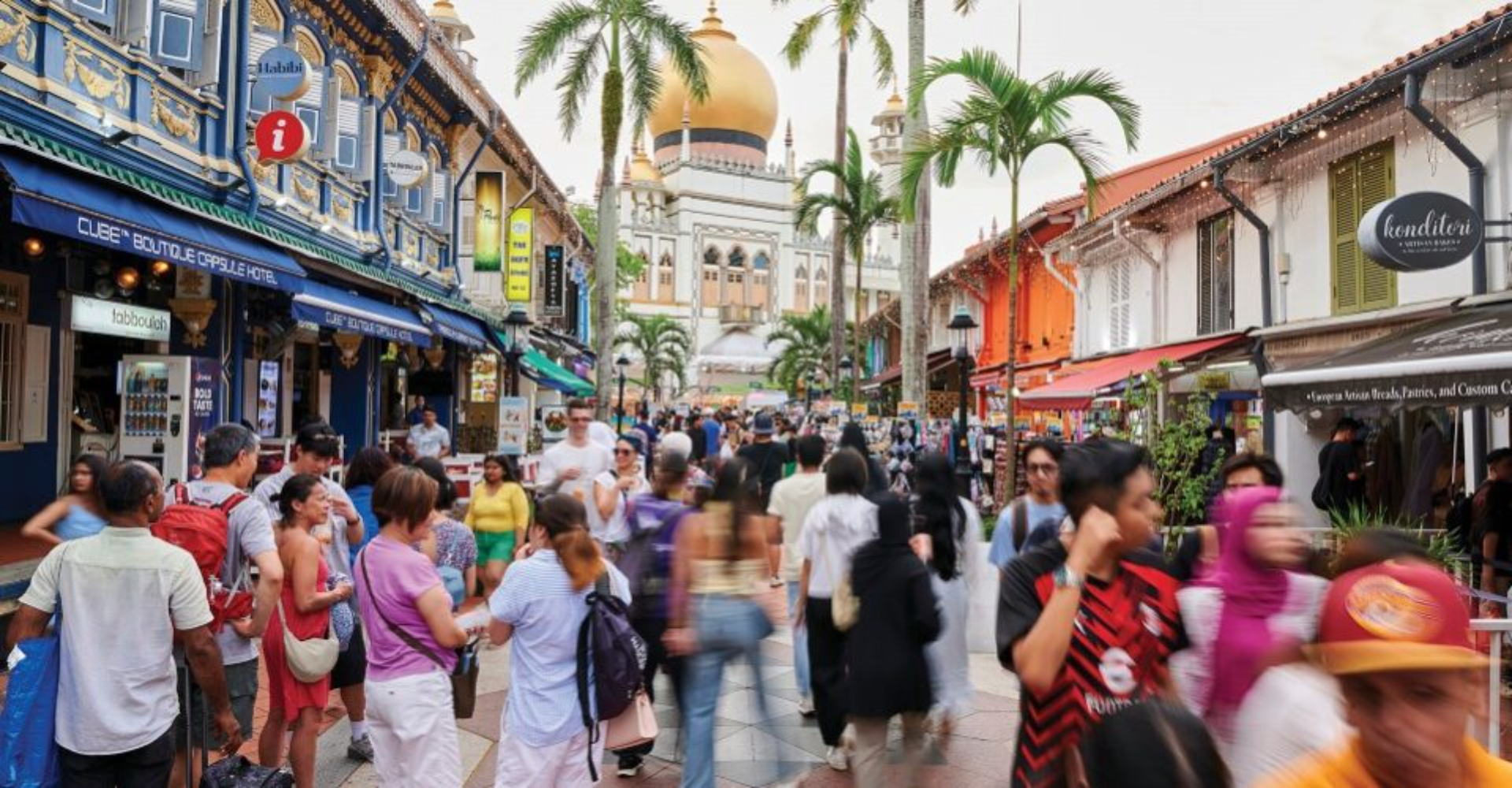
Arriving in Kampong Gelam, you’ll find that along Arab Street, textile shops that opened in the 1970s and 1980s still sell richly patterned batik fabrics—a holdover from its long-standing role as the heart of Singapore’s Muslim community. Today, the neighbourhood has layered that heritage with a lively mix of independent boutiques and hip cafés, while the gold-domed Sultan Mosque continues to anchor the area.
You’ll know you’re in Kampong Gelam, also known as the Muslim Quarter and Perfume Alley, when you start to spot—and smell—attar shops, where alcohol-free scents are crafted from essential oils. Many Muslims apply attar before entering a mosque to pray or for certain religious occasions. The techniques of preparing these fragrances have been passed down from master perfumers to their apprentices, and these shops continue to hold strong today.
One of the oldest attar shops in the neighbourhood is Jamal Kazura Aromatics, which was established in 1933. Their location on North Bridge Road, just off Arab Street, continues to blend, customize and sell fragrances nearly 100 years later. Another long-running attar shop is VSS Varusai Mohamed and Sons, a century-old family business. Fauzia Rani, the first woman in the family trade, now works with her father Haji V. Syed Mohamed to operate the company that her grandfather launched. You’ll find several other perfume businesses along Arab Street or nearby, including Aljunied Brothers, Unta Aromatics, Sifr Aromatics and Thahirah Kazura.
.jpg)
.jpg)
.jpg)
.jpg)
Tanjong Pagar
Track down all the best Korean snack, beauty and fashion finds
Compared to its Chinese, Malay and Indian communities, Singapore’s Korean population is much smaller. Although only 21,000 Koreans live in the city, the community is quite strong along a stretch of Tanjong Pagar Road near Duxton Hill, which has now become informally known as the city’s Little Korea. You’ll realize you’ve arrived when Korean script replaces the Chinese characters or English lettering on the businesses’ illuminated signs.
While you’ll certainly find Korean cuisine here—at restaurants such as Flower Pig 360 and Super Star K, known for their sizzling barbecue— and K-pop music at local bars and karaoke joints like Fiveten or Illuzion, some of the best finds in the neighbourhood are the snack, beauty and fashion goods straight from the trendy streets of Seoul.
Wander the aisles of Koryo Mart Tanjong Pagar to pickup Korean snacks like dried persimmons, crispy seaweed chips or ramen noodles, and K-beauty products including face masks, soaps and cosmetics. Lee Mart, another Korean supermarket, has an outlet nearby for more food and skincare options ranging from ginseng drinks to lavish lotions and shampoos. If you want to treat yourself, get your hair styled at a salon like On Hair or walk about 20 minutes outside the neighbourhood to pick up the latest K-fashion finds from Jeje Korean.