



.jpg)
On top of the visual beauty of Laskin’s work, he also pioneered the use of ergonomic bevels in 1988 to ease the strain of draping your arm around a guitar. In his not-so-spare time, he also ran a record label dedicated to Canadian folk for 25 years and co-founded the Canadian Folk Music Awards. Oh, and he’s a novelist who has written speculative political thrillers.
Laskin, 72, still builds acoustic steel-string guitars, the kind heard in the vast majority of folk, rock, pop and country music. He speaks of his luthier work in the third person: he doesn’t make guitars, he makes “Laskins.” And unless he’s replacing a broken or lost instrument, he never repeats the same design twice. A quick flip through his portfolio—collected in two hardcover coffee-table books—and it’s easy to see why the world’s top musicians will wait up to four years for one of his guitars with custom decorative inlay.
Renowned Canadian flamenco guitarist Jesse Cook has certainly used his Laskins: he has commissioned two, one of which was his main performance instrument for about 15 years, and they’ve endured the hardships of the road. “He gigged around the earth, moving from climate zone to climate zone,” Laskin says of Cook. “And older Spanish guitars would screw up and become unplayable or cracked, but mine were so stable.” Cook has previously said that even though he’d always have a backup guitar on stage in case he broke a string, he would still prefer to interrupt his set to restring Laskin’s rather than reach for the backup.
.jpg)
“I love the pleasure of building the guitars. I want to carve the neck myself. I don’t want a machine to do it, even though I know they can do a thousand in a day perfectly. That doesn’t interest me. I’m sculpting.” —Grit Laskin
.jpg)
.jpg)
Laskin’s journey to find his calling goes as far back as the 1960s when he tried woodworking at summer camp. However, as a teen, he was more interested in folk music and sound engineering. At 17, he dropped out of his Hamilton high school and hitchhiked to Toronto, walking into a recording studio where he knew Bruce Cockburn’s first album was made. He asked for a job and got it, working on ad jingles, early IMAX films and the Sesame Street theme song. When he left after just six months, they had to hire three people to replace him.
Then, at the 1971 Mariposa Folk Festival, he met Jean Larivée, who had a booth in the craft area. There were no well-known Canadian luthiers at that time. Larivée had recently studied lutherie from a German immigrant. The still-teenage Laskin became his apprentice that fall. He opened his own shop in 1973. “Before I even bought a chisel for my new shop, I had three orders from people who knew I was leaving Jean and knew my work,” he recalls. “I have never not had orders.”
In 1991, he formed an artists’ co-op to buy an old mattress factory in Toronto’s west end, to convert into studios. It was during a recession, and they got it for half the asking price. Inside, he uses the same type of tools he’s been working with since the 1970s. The only computer in the space is the one he uses for email. He plans his guitar designs using a type of tracing film from the dental industry. The walls of each room are sealed, with vapour barriers on the floor. The room temperature is kept at a consistent 23 degrees Celsius and floor humidifiers ensure 43 per cent humidity throughout, to prevent the wood and glue on the guitars from shrinking or expanding.
Laskin clearly loves what he does, every part of it. “I value it in so many ways,” he says. “Not just the inlay, which turns my visual creative crank, but I love the pleasure of building the guitars. I want to carve the neck myself. I don’t want a machine to do it, even though I know they can do a thousand in a day perfectly. That doesn’t interest me. I’m sculpting.”
.jpg)
He practically squeals with delight as he continues: “I bend wood over a hot pipe, freehand. I can bend a standard set of sides in 20, 25 minutes and they’re done. That makes your day!” The rest of the process takes considerably longer. Laskin now makes about six guitars a year; in his earliest days, he made two a month. As the designs got more intricate, the assembly time naturally got longer.
The artwork involves long consultations with the client. Laskin says he feels “like their armchair psychologist” as he tries to extract themes from their conversations that he could represent visually in a meaningful way. “I’m trying to get a sense of what’s in their head,” he says. “I want to be really sure I’m on their wavelength.” In the process, many clients become lifelong friends; Laskin always has a guest room where he can crash in Oslo, Tokyo, New York, wherever.
Surely, though, some clients are a pain? “Generally not,” he says. “I have to admit, I'm pretty spoiled. There have been some odd requests, but not for a long time. One person wanted an inlay with a bird on the headstock and its poop fell down the frets and collected in a pile at the bottom. I said, ‘Really? It’s your guitar, you’re paying me for it, but my name is on the inside. I’ll get the blame. So no, I’m not going to do it.’”
Of course, craft comes at a cost: Laskin says his base for any commission is $26,500 (USD $19,500). Depending on the client’s request for the level of detail or types of wood—Honduran mahogany? Flamed purpleheart? Brazilian rosewood?—that number could climb closer to $40,000 (USD $29,000).
Now, if you just spent that much on an instrument, one that has a personal story of yours represented visually and has been custom made to fit your body, would you not be terrified to ever leave your house or studio with it?
“There are a number of performers who keep these guitars in their home or in the studio,” Laskin admits. “On stage, they bring cheap ones, so they don’t care if the airline screws them up or an amp falls on them on stage. But they’ll keep [mine] in the studio to record because they want a good sound. Or they use it at home to inspire songwriting.”
.jpg)
.jpg)
“Before I even bought a chisel for my new shop, I had three orders… I have never not had orders.” —Grit Laskin
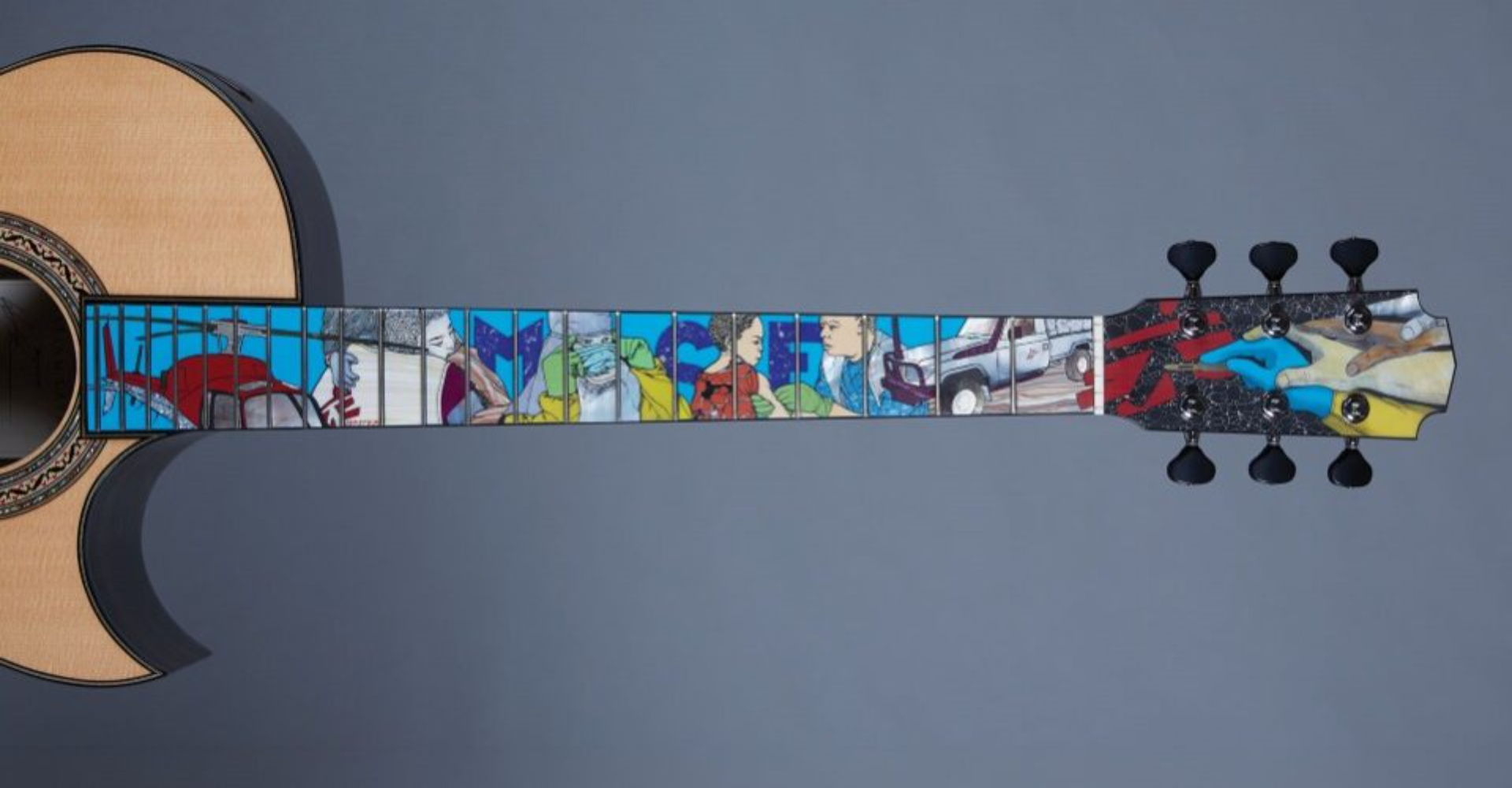
Laskin would like his work to inspire change as well. He’s passionate about human rights, which shows up often in his work. When we spoke, he’d just been commissioned by a non-profit trying to shift manufacturers away from conflict metals and blood diamonds.
Whether the work is political or personal, Laskin cherishes the connection with his clients. “It becomes such a satisfyingly rich transaction that is the antithesis of our digital culture,” he says. “Human beings need the tactile and seek it.”