


The land now known as Vancouver sits on an inlet fed by the Salish Sea, a body of water once integral to the lives of the Squamish, Musqueam and Tsleil-Waututh peoples. Today, this land remains the ancestral and unceded territory of these three First Nations. Over the past decade, to acknowledge this reality and celebrate Indigenous creativity and artistry, the City of Vancouver and several local non-profits have commissioned more than 30 temporary and permanent murals by local Indigenous artists. Here are five murals by five First Nations artists—in some cases, multi-artist collaborations—to check out around Vancouver.
“Blanketing the City 1”
Debra Sparrow (Musqueam)
Location: Granville Island
Self-taught artist and master weaver Debra Sparrow grew up on the Musqueam Reserve and has played a vital role in the preservation of Coast Salish art and culture.
Her first mural for the series Blanketing the City, which includes five murals across the Lower Mainland, was commissioned by the Vancouver Mural Festival (VMF), a now-defunct non-profit that supported a rich public-art project in the city from 2016 to 2024.
The 13-metre-high work underneath the Granville Street Bridge incorporates elements of traditional Coast Salish textile design, with shapes and colours adapted from existing weavings by Sparrow.
In an interview about the piece for VMF, Sparrow said:
“For me, it’s the foundation of our people rising up through these pillars. All of these beautiful designs are significant of a history that’s been silenced for over 200 years. It represents all of the Salish people, not just Musqueam or Tsleil-Waututh or Squamish. We had a village site here. The pillars are holding up the bridge but holding up history as well.”

“The Healing Quilt: Blanketing Our Lost Loved Ones”
Jerry Whitehead (Cree)
Sharifah Marsden (Anishinaabe)
Corey Larocque (Cree / Gitxan / Haida)
Location: Downtown Eastside
In the heart of Vancouver’s Downtown Eastside neighbourhood stands a mural with particularly poignant significance.
Cree artist Jerry Whitehead was commissioned by the Portland Hotel Society—along with several other local social-service non-profits, the City of Vancouver, and VMF—to create a mural commemorating community members lost to the toxic-drug crisis.
In collaboration with Anishinaabe artist Sharifah Marsden and Cree/Gitxan/Haida artist Corey Larocque, Whitehead designed a thunderbird and a star blanket that cover the entire western façade of 20 West Hastings Street.
“We initiated this project as a way to uplift the community,” said Dalannah Gail Bowen of the Downtown Eastside Centre for the Arts.
The mural includes a quote from local poet Bud Osborn that reads:
“There is no one to care if you do not care.”
At the bottom of the mural, community members have added the names of loved ones lost to overdose.

“Dreamweaver”
James Harry & Lauren Brevner (Squamish)
Location: Downtown
Commissioned at the height of the pandemic in 2020, Squamish artists James Harry and Lauren Brevner’s mural at the Bentall Centre in Downtown Vancouver was created in response to the killing of George Floyd and the emergence of the Black Lives Matter movement in the summer of 2020.
The work incorporates elements of traditional Coast Salish design, depicting two women—one Indigenous and one Black—standing back-to-back. They are wrapped in a ceremonial Salish button blanket that features a thunderbird on one side and a wolf on the other.
In their artist statement, Harry and Brevner said the artwork reflects not only their refusal to remain silent during turbulent times; it also: “serves as a visual embodiment of our commitment to BLM and global unity.”
Harry added in a social-media post that Dreamweaver is: “an intentional blend of cultures—a symmetrical, teachable, powerful reclamation of minority groups in the Lower Mainland.”
“The Matriarch”
Siobhan Joseph (Squamish)
Location: Mount Pleasant
Central Mount Pleasant is home to the city’s largest number of public murals, thanks to the Vancouver Mural Festival’s legacy of painting new walls in the area each year.
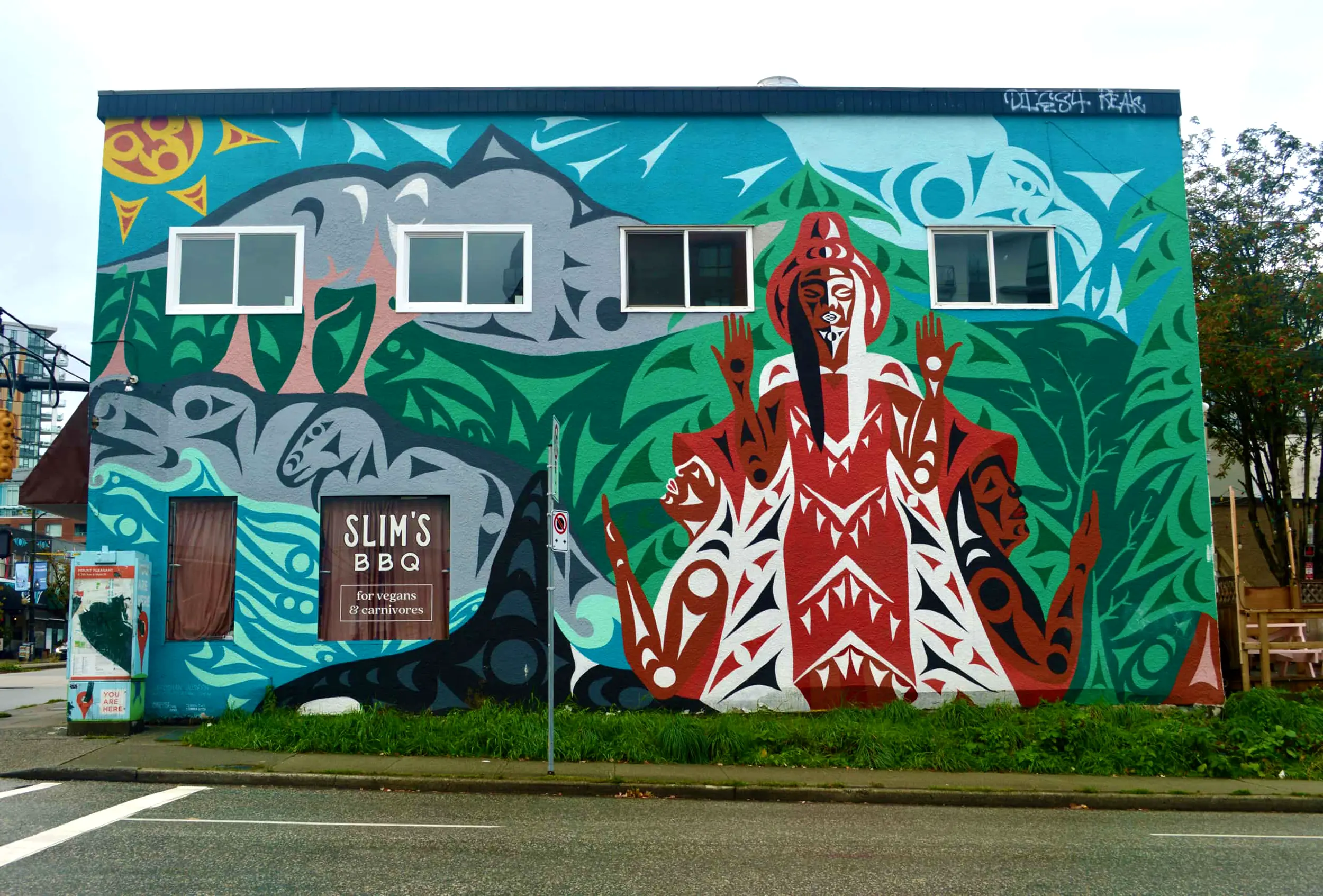
Just up the street from Paul Windsor’s mural, on the north side of a building that currently houses the restaurant Slim’s BBQ, Squamish artist Siobhan Joseph’s The Matriarch commands attention.
Joseph says she was inspired by her late mother, who was a fierce protector of the family.
She envisioned a woman standing with her hands open in a gesture of welcome and gratitude, flanked by a man and a woman on either side to represent the support of community.
The matriarch wears red to honour Missing and Murdered Indigenous Women and Girls (MMIWG).
“When I first encountered Siobhan’s work, I was immediately drawn in,” said Kwakwaka’wakw, Nisga’a and Tsimshian curator Linnea Dick in an interview with VMF, “because I think that she really works within the realm of traditional Coast Salish art, but the way that she story-tells is more contemporary.”

“Eagle Opens Up”
Paul Windsor (Haida / Heiltsuk)
Location: Mount Pleasant
In an alleyway tucked just off Main Street at 5th Avenue, in the vibrant Mount Pleasant neighbourhood, is Haida/Heiltsuk artist Paul Windsor’s Eagle Opens Up.
This bright, elegant mural depicts half an eagle’s face and wingspan sweeping across the top of the wall, with colourful hummingbirds and salmon below.
“I’m a traditional artist, using these forms and elements known as the ovoids and the U-shapes and the S-forms,” Windsor said in an interview for VMF.
“I’ve studied a lot of traditional pieces and watched a lot of carvers from different nations do their thing and kind of learned.”
The mural was commissioned in partnership with Vancouver’s Urban Native Youth Association, a local non-profit created to empower Indigenous youth. Some of those youth contributed to the mural by painting salmon roe and other elements.
“That’s what the culture’s about—it’s about sharing and giving,” said Windsor.
“So to come and do this and expose some artwork to the community, it’s an honour.”